There is a particularly uncomfortable kind of startup to be running right now.
You are not failing. You grew 60% since last year. Customers like the product. You are inching towards profitability at $1.5–2m ARR, without having raised much. By almost any normal business standard, things are going well.
But the companies around you inhabit a different universe. One goes from zero to $20m ARR in twelve months. Another has no revenue and no plans for any, and raises $40m because it is building data centers under water. Investors look at you and see something perfectly decent that is not moving fast enough.
SVB State of the Markets H2 2026
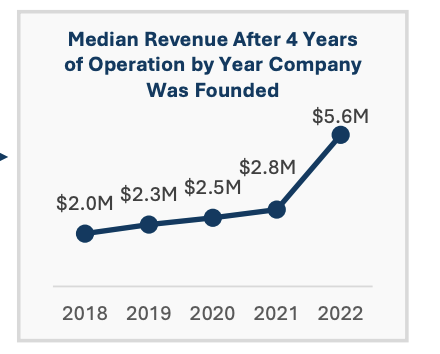
Before accepting that verdict, look at what actually changed. SVB tracks median revenue by years since founding. For companies founded in 2018 through 2021, the median was doing $2.0m to $2.8m four years in. For the 2022 cohort, it was $5.6m. The historical norm was $2m to $3m at that age. It also doesn't help that every day a new competitor seems to be springing up. The comparison set more than doubled underneath them in a single cohort year, and the bar moved with it. It means the verdict you are being given is partly about the market's clock and not only about your company.
Now What?
The standard advice is clear. Pivot. Sell or shut down. Or accept that this is a good business rather than a venture-scale one, and run it accordingly. Those are all legitimate answers.
But there might be a fourth.
Procore was founded in 2002. Ten years later it was doing roughly $4.8m of revenue. That sounds like a decade of stagnation. It probably wasn't. Reaching $4.8m from a few hundred thousand implies compounding at something like 50–60% a year for most of the decade. The growth rate was fine. The base was small and the elapsed time was long, and from outside those are indistinguishable from going nowhere. Bessemer, who eventually invested at $5m ARR, described a decade of struggling for adoption at a company that sometimes could not make payroll. At almost any point in that decade, it would have been easy to conclude the experiment had run its course.
Usually that conclusion is correct.
Persistence is one of the most dangerous virtues in startups.
Almost every bad company can construct a story about why it is simply early, and the graveyard is full of founders who waited for a market that never arrived. So the question is not whether slow-growing companies sometimes become large ones. They do, rarely. It is whether you can tell, from inside, which one you are.
I think you mostly can.
The test is simple to state and hard to pass: > If revenue is not compounding quickly, something else has to be. I suggest three places to look.
One: Is the Constraint Shrinking?
Procore was waiting for the customer environment to catch up. Sites had terrible connectivity, smartphones were not ubiquitous, tablets did not exist. Over time those constraints disappeared. The company did not discover a different problem; the world became better suited to the one it had spent years solving.
That is one path. Survive until the constraint disappears.
But mobile arriving did not harvest itself. Procore also built an inside sales engine, and the growth rate doubled only when both happened together. The constraint lifting is necessary, not sufficient. A company that waits without getting ready to convert just watches someone else take the market it correctly predicted.
And "customers aren't ready yet" is not a strategy. It is a mood. The test is whether you can name the specific thing preventing adoption, measure it, and watch it weaken.
Maybe inference costs need to fall another 80%. Maybe a piece of regulation needs to come into force. Maybe a sensor needs to get cheap enough.
Each of those is a number you can put on a slide and update every quarter. If you cannot express your constraint that way, you probably do not have one. You have a hope.
Two: Is the Problem Growing?
The second test holds you constant.
If you got no better at anything from today, would the world make your product more valuable in three years? For some companies, yes, because the problem itself gets worse every year.
A developer tool serving browser fragmentation looks narrow, but every new browser, device and screen creates more of the complexity it resolves. A security product looks niche, but machine identities, agents and generated codebases are multiplying underneath it.
In those companies, time is doing some of the growth for you.
If yes, your current revenue curve may be misleading. If no, slow growth deserves a harsher reading, because every future dollar has to be manufactured by you.
Three: Is the Company Accumulating?
The first two tests are about the world changing.
The third is about the company having quietly built something the revenue line does not capture. Sometimes the business you set out to build is wrong, but the years spent building it produced the business you should build instead. The lesson is not "pivot". It is that failure produces assets.
A team four years into the wrong product knows things a team starting tomorrow does not.
What accumulates comes in two forms, and they need different tests.
The first is latent: knowledge, infrastructure, an unusual capability with no product attached to it yet. It is worth nothing until someone finds the application. The test is whether you can name one you could not have reached from a standing start.
UiPath is the cleanest example.
Founded in 2005 as DeskOver, it spent nine years selling automation libraries to other software vendors, and by 2014 was doing $500k of revenue with ten employees. But it produced deep expertise in Windows desktop automation, which turned out to be the hard part of robotic process automation. The company redirected to RPA in 2012, rebranded in 2015, and then went roughly $1m, $3.5m, $30m, $155m in four years.
The second already exists: a working thing with at least one real user, usually you. The test is harder than it looks: was the friction you solved generic to your industry, or specific to your company? The most common variant of that is some internal tool you have built that you bet the whole company on. AWS is of course the classic example. But in the context of this post, I'd point you towards Atlan, which started as a data viz startup for NGOs and governments and ended up building a bunch of internal tools to solve their own problems.
You can see their history here:
Fun fact: Atlan was one of three products that they were exploring to build a business around. It was the smallest in revenue with the highest scale potential.
Focus is hard, and saying no is what sets you up for success. A small business can earn the right to become a large one. Every customer in a narrow workflow might be handing you something transferable: for e.g data, distribution, trust, workflow ownership
Which is why "start with a niche" is incomplete advice. Plenty of niches stay niches. The question is whether dominating the small one creates something a new entrant cannot recreate. If all you accumulate is revenue, you have a nice small business. If you accumulate an asset, the first business is a staging ground rather than a destination.
So the question in both cases is the same:
What did the last four years accidentally make valuable?
The Obvious Objection: AI Changes the Game
None of this, someone will say, survives contact with the current moment. Procore could wait a decade because building took a decade. If building is now cheap, the day your constraint lifts twenty teams walk through the door at once. Waiting no longer reserves your place. That is partly right, and it changes the durations.
An eight-year germination is probably no longer financeable. If the constraint you are naming is four or more years out, treat that as a no rather than a maybe. But the tests get sharper.
Naming a constraint used to be a qualitative bet: a founder in 2010 saying "tablets need to exist" was guessing. Today's constraints are legible. Cost per token, Reliability across N steps of autonomy, A commencement date in a statute. You can chart yours monthly, which also means you can be proven wrong quickly.
What genuinely gets harder is the third test. Proprietary data, workflow knowledge and integrations were the standard moat list, and much of that list became cheaper to replicate.
So raise the bar:
What do we have that a frontier model plus a competent team plus a weekend cannot recreate? If you cannot answer that, the problem was never your growth rate.
One related thing not to rely on: your better-funded competitors dying. They might. They might also use the money to hire the best people and win the customers. Competitor mortality is not a strategy. The useful version is that they may be paying to educate the market for you, and you only need to survive the period in which they do it.
The Odds
So should these companies keep going?
Of the companies I have watched sit between $1m and $5m for four years or more, I would put the base rate under one in ten, and I would want any founder reading this to plan on being in the remaining ninety percent. The outliers are useful not because they are likely, but because they tell you what had to be different.
Something was compounding when revenue was not.
The technology was improving. The customer was changing. The problem was getting larger. The company was accumulating something unusual. If none of that is happening, you are not germinating.
You are stagnating.
Who Pays for the Wait?
Suppose you run all three tests and conclude you are germinating. Venture capital is a poor instrument for germination, certainly in this market. An investor can believe you are right about the world and still be unable to act on it. So the strategy has to include the financing, not just the diagnosis.
Worth exploring: Bootstrapping, Structured rounds — insiders might fund it if the thesis is real; terms will suck, but better than no terms, Revenue-based financing — if the business is growing and retentive, Grants — constraints attached, but non-dilutive, A strategic who values the asset early
The Question
The question you should be asking yourself is:
If I spend another three years on this, what will be dramatically more valuable at the end of it than it is today?
If the answer is "nothing, except hopefully our revenue", the hard choices might be the right ones. If the answer is something specific, measurable, and getting stronger, then unfundable is a statement about the market's clock, not about your company.